Steam Cleaning Vs Chemical Cleaning
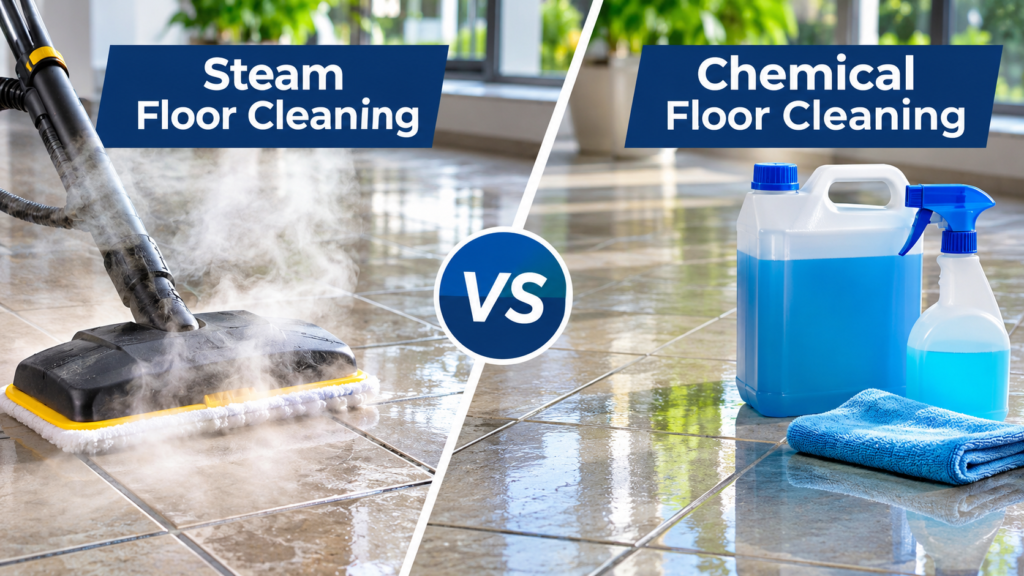
Steam Cleaning Vs Chemical Cleaning For Tiles And Grout: Which Works Better?
Stand in a busy café and look at the floor. By the door, wet shoes have walked in grit and street dirt. A few metres on, round the service counter, there’s a film of cooking grease and dropped food.
Both patches certainly look grubby. They got that way for different reasons. Cleaning them also takes different approaches.
Which would you go for: steam or chemicals?
Steam loosens everyday dirt. The surface just has to be able to take the heat. The right cleaning product does a better job on particular deposits, grease and soap scum among them. And on a really dirty floor, how you scrub and how you get the dirty water off again counts for as much as whether you used heat or detergent.
A solid porcelain kitchen floor and a marble bathroom with fragile joints are both “tiled”, and that’s about all they share. Before you pick a method, find out what the floor is made of, what’s stuck to it and whether the grout is still in one piece.
What People Mean By Steam Cleaning
You’ll hear “steam” a lot in cleaning adverts. At least three different machines get called steam cleaners, and they put very different amounts of heat, water and pressure onto a floor. So which of them is in the works?
Most homes have a steam mop. Pretty nifty to use: it heats water in a small tank and pushes the steam through a cloth pad. The heat breaks down the grime and the pad wipes some of it up. The pad is the weak point. Once it’s loaded with dirt, it just carries that dirt on to the next few tiles.
A handheld or canister steam cleaner fires steam through a nozzle at a much smaller area. That’s handy for one stubborn spot, and risky near cracked grout, silicone, decorative finishes and tile edges. People assume that because it’s only water it can’t do harm. Concentrated heat and pressure can.
Then there are the machines that get called steam cleaners and actually spray hot water, often with a cleaning solution, a spinning brush head and suction. Technically, hot water and vapour steam are different states (remember high school class?). A professional rig will usually rinse the floor and vacuum the dirty water back up as it goes. So here it comes down to what gets to the floor, and how the dirt is extracted.
What Chemical Cleaning Means
“Chemical cleaning” sounds as if someone’s about to whip out the strongest bottle from the cupboard. Most tile cleaning is far tamer than that. Warm water, a mild detergent, a cloth or brush and a proper rinse see off most everyday spills.
Start with the everyday products. Their job is to release ordinary dirt so it can be wiped, mopped or vacuumed away. For most floors that means a neutral cleaner, depending on what the tile supplier’s care instructions say. Neutral doesn’t mean safe on everything, mind, and a stronger mix doesn’t clean better.
Different dirt needs different chemistry. Cooking fat and oily films want a degreaser. Soap scum and body oils in a shower are a different mix again. Limescale and other mineral deposits call for an acidic cleaner, and those can damage cement grout and acid-sensitive stone. A product that’s perfect on one ceramic tile can be completely wrong for the material next to it.
Of course, even the right product won’t do all the work for you.
You still need to leave it on for the right time, work in with a brush where the floor allows it, and then remove it along with the dirt. Some cleaners need rinsing and some don’t, so go by the label and by what the floor supplier says. Ignore “industrial strength” on the front of the bottle. A good product is one that suits the job and comes with directions you can actually follow.
A set of floor-cleaning instructions should cover three things:
- physical action (which mop, brush or scrubber);
- Chemical involved (which product, at what dilution, for how long) and;
- water temperature.
Nearly every clean uses a bit of each.
Steam vs Chemical Cleaning for Tile & Grout Care
A freshly cleaned tile looks great while it’s still wet. Once it has dried, when the residue, pale patches and uneven grout colour show up again, it’s a different issue. So you need to go beyond ‘first looks’.
| Factor | Steam, On A Floor That Can Take It | The Right Chemical Cleaner |
|---|---|---|
| Everyday light dirt | Loosens it well, provided the pad is clean | A correctly diluted floor cleaner usually does the job |
| Grease and oily film | Heat softens it, but it still has to be picked up | A degreaser is made for exactly this |
| Limescale and grout haze | Unreliable, because these deposits are chemically bonded | A specialist product can work if the tile and grout tolerate it |
| Weak joints or delicate finishes | Heat, pressure and moisture can rule it out | Some products do damage here too, so check first |
| Getting the dirt off the floor | Down to pads, wiping or a separate extraction step | Down to rinsing, wiping or wet vacuuming |
| Busy commercial areas | Needs planning for hot equipment and access | Needs planning for chemical safety, slips and access |
Nobody can call a method the fastest, safest or deepest clean without testing it on your floor and your dirt.
You are basically dealing with four things: how much dirt came off, whether the grout or any coating has changed, how the floor feels underfoot and whether a film has been left behind. If either test does damage, or you don’t know what the surface is, stop there.
Also, how much will the cleaning disrupt your activities? At home that might mean shifting some furniture. In a shop or office, a spotless result isn’t much use if it leaves a wet walkway during opening hours.
Where Steam Can Earn Its Place
Steam has a proper place in looking after tiles, as long as the floor can take it. A sound ceramic or porcelain floor is one thing. Natural stone with a delicate finish, or a bathroom where the grout is already coming away, is quite another.
Say your kitchen floor gets the usual build-up round the table legs. If the tile, the grout, any sealer and the machine’s own instructions all allow steam, a steam mop will lift that film nicely. It’s convenient for small areas where mixing up a bucket of cleaner hardly seems worth it. Use a clean pad, and don’t leave the floor soaking.
In tighter spots, a steam nozzle used with care will shift dirt from grout that’s in good condition. Don’t hold it still against a weak joint for the sake of a slightly brighter line. The grout supports the edges of the tiles, and a jet held in one place can blast it out.
Shower walls are another candidate, though bathrooms need extra thought. The silicone round the corners and fittings isn’t grout, and a jet aimed into a failing joint can drive water into places that are meant to stay dry. If the sealant is lifting or there are signs of damp in the wall, get that fixed before you plan another deep clean.
Steam has a weakness as well. It loosens dirt without necessarily picking it up. Finish by pushing a sodden pad over the same tiles and you’ve only moved the muck to a new address. Change or wash the pad as you go, and be ready to wipe or vacuum the floor afterwards.
Where A Suitable Cleaner Has The Advantage
Chemical cleaning comes into its own when you know what’s holding the dirt in place. Take the tiles behind a food-prep counter. The mix of fat, splashes and foot traffic there is nothing like the muddy film at the front door. Heat helps with grease, certainly. A degreaser, though, is made to break up oil so that it can be rinsed away.
In a bathroom you often get several films on top of each other: soap scum, skin oils and limescale. One cleaner might clear the oily part and leave the mineral part untouched. The product hasn’t failed. You’ve got two problems and it was only made for one of them. Before you bring in a specialist cleaner for the other, check it against both the tile and the grout, above all if it’s acidic.
At a shop entrance, where nearly all the dirt arrives on shoes, scrubbing with a floor detergent and then removing the dirty solution will do more than a long session with steam. Over a big area a scrubber-dryer makes sense, so long as its pad and cleaning solution suit the finish.
Don’t leave a product sitting on the floor on the theory that longer must mean cleaner. The contact time is on the label, and some cleaners must never be allowed to dry on. Measure the dose as well. It affects how well the product cleans, how much residue it leaves and how safe the surface is to walk on afterwards.
Businesses get one more benefit. A named product with a set dilution and rinse procedure can be written down and repeated. A cleaning team working from that gets far more consistent results than one where every shift improvises with whatever’s in the cupboard.
Cement, Epoxy And Silicone Factor
What’s between the tiles can decide the cleaning method even when the tile itself is tough. Look closely at the joints before you point a nozzle at them or open a specialist cleaner.
- Cement grout is more porous than glazed tile, so it holds on to stains. It’s also vulnerable to acid. Acid can dissolve cement-based material, so a stain may seem to lift when what has really gone is the top of the grout. Keep doing that and there’s a little less grout each time. Try a mild cleaner and proper removal of the dirty water first.
- Epoxy and other resin grouts behave differently. They generally resist stains and chemicals better, but the exact formulation and how well it was installed still matter. Don’t assume every resin grout will put up with every acid, degreaser, pad or steam treatment. Look up its technical sheet, especially on a commercial floor where the grout was chosen for a particular cleaning regime.
- Silicone joints aren’t grout at all. They’re flexible seals used in corners and round fittings, where the building moves a little. Once they’ve split, come away or opened up, no amount of cleaning will make them watertight again. A hot jet aimed at their edges is a bad idea even where the tiles next to them are fine with steam. Failed sealant needs cutting out and replacing.
Go carefully with old grout. A dated shower in a rented flat can have loose joints hidden under the dirt. In a busy changing room, years of cleaning may have exposed gaps and crumbly sections. Test gently first. If bits come away under a light brushing, or you can see cracks, stop and get it looked at.
Tile Type Matters As Much As Grout
“Tile” is a family of materials, and they don’t all tolerate the same chemicals and temperatures.
Glazed ceramic has a glassy surface layer that makes ordinary dirt easy to remove. Decorative glazes, coatings and worn patches can still be scratched by abrasive tools. A tile can look tough and have a fragile special finish. If you can’t find the care instructions, go gently and test a patch nobody will see.
Porcelain is dense and hard-wearing, which is why it turns up in kitchens, hallways and shops. Smooth porcelain and textured anti-slip porcelain still need cleaning differently. A flat pad barely touches dirt sitting down in a textured surface. And a pad that’s fine on one finish can be too harsh for another, particularly where a surface treatment has been added.
Quarry and other unglazed tiles are more porous, and they may or may not have been sealed. That changes how dirt sits on them and how thoroughly the cleaning liquid has to be picked up. They look as if they’d stand up to anything. Don’t take that as licence to use whatever chemical is to hand.
Natural stone like marble, limestone and travertine contains calcium carbonate. They don’t get along with acid. Use the wrong cleaner and you could end up with dull, etched patches. And no, another round of cleaning won’t bring the shine back.
Granite and the other silica-based stones are hardier, but they can still contain acid-sensitive minerals or carry a treatment that isn’t. “Natural stone” on a receipt tells you very little, and you can’t judge “steam-safe” by looking.
Add a polish, a topical coating, an anti-slip treatment or an impregnating sealer and the question gets narrower again. Before a first deep clean, find out what’s been applied and what it can tolerate. If the paperwork is long gone, a tile or stone specialist can assess a test area, which beats gambling on the whole room.
The Soil That Steam May Not Remove
It’s tempting to keep going at a stubborn mark until it gives way. Some marks won’t give way to a hotter nozzle. They need a different diagnosis, and a few can’t be cleaned off at all.
Take grout haze, the film sometimes left on tiles after grouting. What it’s made of depends on the grout and how the job was done. The remover has to be one approved for that material, and heat alone may not touch it. A newly laid floor also has curing times and first-clean instructions, so a keen deep clean too early can cause fresh problems. Speak to the installer or the grout supplier before trying anything specialist.
Limescale and other mineral deposits are a separate matter. Round a shower or sink, hard water leaves minerals behind as it dries. Established deposits usually need a specialist product, and there’s no acid that’s safe on everything. Marble, limestone, travertine, cement grout and some coatings are all at risk. A descaler that strips limescale off one surface can etch the one beside it.
Efflorescence shows up as a whitish deposit on grout. It forms when moisture moving through the floor carries dissolved salts to the surface and leaves them there as it evaporates. That’s a different thing from soap film or detergent left after mopping. Ongoing moisture movement can be part of the cause. Clean the surface without dealing with the moisture and the deposit is likely to come back.
And then there’s plain wear. A scratched glaze, a worn coating, faded grout pigment or an etched stone tile will look dull however clean it is. Steam can’t put back a finish that has physically or chemically changed, and nor can a stronger cleaner. The next step there is stone restoration, regrouting or some other repair.
Use a test patch to tell a film you can remove from a defect you can’t. If the finish is still dull after a suitable clean and a full dry, don’t keep escalating. Get a specialist to look at it before you buy a fourth and fifth bottle.
Cleaning Is Not The Same As Disinfecting
A floor can look clean and not be disinfected. Pour disinfectant over visible dirt and the dirt is still there. They’re separate jobs, and the steam-or-chemicals question shouldn’t be allowed to blur them.
Cleaning physically removes dirt, and a good share of the germs with it, using water, detergent and scrubbing. Disinfecting uses a proven process to kill particular microorganisms under set conditions. The surface, the method, the contact time and any cleaning beforehand all affect whether it works.
Some steam machines are sold on claims about killing germs. Those claims don’t automatically carry over to your floor, your grout or the way you use the machine. The temperature in the boiler is higher than the temperature at the tile, and the heat has to stay on one spot long enough to work. How fast you move, how the machine is built and the state of the surface all change the result. Unless the process has been properly validated for the use you have in mind, don’t count a pass with a steam mop as disinfection, and certainly not as sterilisation.
In an ordinary home, cleaning is usually enough for routine floor care. Disinfecting as well makes sense in some situations, after certain illnesses for instance, and then you should follow public-health advice and the product’s instructions. Bear in mind that a given disinfectant may not suit natural stone, some coatings or some grouts.
Commercial premises often have set requirements. A food business has to follow the hygiene arrangements for its own activities, and the rules for food-contact surfaces differ from those for floors. A healthcare setting, a crèche or a managed washroom will usually have a written cleaning and disinfection policy. A contractor can’t replace that with an unsupported line about steam sanitising everything.
Where disinfection really is required, choose an authorised product or a validated process for the setting, follow its instructions and record what was done. A thorough clean that’s safe for the surface comes first.
Chemicals Have Risks, But So Does Heat And Water
“Steam is only water, so it must be harmless. Chemicals come in bottles, so they must be dangerous.”
That’s not how it works.
There are all sorts of cleaning chemicals. Some everyday products carry little risk if you handle them properly. Others irritate skin, damage finishes or give off dangerous fumes when misused. Follow the label and the safety information on dilution, gloves, ventilation and storage. Never mix cleaning products. Bleach in particular must not be combined with acids, ammonia or other cleaners.
Steam brings risks of its own: hot parts, scalding vapour, moisture forced into joints and damage to sealers or finishes that can’t take heat. A focused jet has no business near loose tiles or failing silicone. And a wet floor is slippery whichever method made it wet. Going without chemicals removes one set of hazards and leaves the rest.
Don’t put a cleaning chemical into a steam machine unless the machine’s instructions specifically allow that product for that use. You can wreck the machine, or end up breathing something you didn’t expect.
The precautions are simple enough: Check that the method suits the whole installation, including the parts you can’t see. Protect whoever is doing the work. Keep children, pets and the public out of the area, and don’t reopen the floor until it’s safe to walk on. That goes for someone cleaning their own kitchen as much as for a commercial team with specialist machines.
What Professional Tile And Grout Cleaners May Combine
A professional job often uses heat, chemistry, scrubbing and wet recovery together, in a controlled order. That doesn’t mean all four belong on every floor. Sometimes the right call is a mild cleaner and a soft brush. Now and then it’s to leave the cleaning alone until a damaged joint has been repaired.
A competent cleaner starts by looking. What tiles are these? Is the grout cement or resin? Is there a coating or sealer? Has the floor ever had polish, wax or a product that left a film? Are the dark lines dirt, or grout that’s breaking down? Five minutes of inspection can prevent a mistake across the whole floor.
Then a small test area shows how the chosen method behaves. Typically that means removing the dry grit, applying a cleaner at the right strength, giving it its contact time, working the textured areas gently and extracting the dirty liquid. With a hot-water system, rinsing and suction happen together. On other floors a separate rinse and a wet vacuum work better. Either way, the aim is to remove what has been loosened.
Professionals also look after the unglamorous details: clean pads, sensible brush pressure, protection for edges, water recovery, proper disposal of the waste water and drying. None of it makes exciting video. All of it affects whether the floor ends up clean and undamaged.
A professional clean is worth considering for ingrained dirt over a large area, awkward textured floors, mixed materials or finishes nobody can identify. What you’re paying for is assessment and control. No honest contractor will promise that a machine can return every tile to how it looked when new.
Homes And Commercial Premises Need Different Plans
A family bathroom and a hotel changing area can have very similar tiles and still need different cleaning plans. Size is only part of it. The dirt is different, and so are the amount of use, the access, the safety duties and how much disruption the place can stand.
At home, a floor tends to have a handful of trouble spots. Kitchen spills are local. The shower collects soap scum round the tray. The hall gets grit and damp marks after a wet day. You can clean one small area, change the cloth or pad, let it dry and check it, all without getting in anyone’s way. Often ordinary maintenance is all that’s needed, and hiring powerful machinery for a routine job is overkill.
There are still limits. A family bathroom with loose tiles or damaged sealant needs repairing before it gets a going-over with steam. Keep children and pets off wet or treated floors, and lock the cleaning products away. And if you aren’t sure whether those handsome kitchen tiles are limestone, don’t try a strong descaler on them just because it worked in another room.
A commercial property has more moving parts. The entrance to a Dublin shop collects wet grit on a rainy morning. A restaurant needs degreasing behind the counter while customers can still get in and out safely. A reception area can have a different finish from the washrooms down the corridor. One machine and one bottle won’t suit every zone, so each surface needs its own written method.
For workplaces, physically segregate wet and drying floor areas with a barrier or cordon until they’re completely dry. A warning sign by itself doesn’t keep people off a wet floor. There’s no universal drying time, so each business has to allow for its own temperature, ventilation, floor and cleaning process.
That makes scheduling part of the quality of the clean. A floor that would otherwise be washed just as customers arrive is safer, and easier to do well, if it’s cleaned in sections or outside opening hours. A building manager should know which products are approved, who’s trained to use them and how residue or drying problems get reported. The choice of product and the plan for access need settling together.
How To Choose The Method For Your Own Floor
Before you buy a steam cleaner, switch detergents or book a deep clean:
- Identify the tile, grout and finish
Find the installation or care information if you can. Look for sealer, coatings, silicone joints, cracks and loose edges. If you still can’t tell what the material is, keep any trial as gentle as possible or ask for advice.
- Work out what the dirt is
Foot-traffic dirt, grease, soap film, limescale and surface damage are five different problems. Look at the floor when it’s completely dry, because a wet floor hides most of them.
- Check the floor is sound
Crumbling grout, lifting sealant, tiles that move or damp that keeps returning all put cleaning on hold. You may need a repair or a moisture survey first.
- Pick a method that suits the floor and test a small area
A mild cleaner is often enough for routine dirt. Steam is an option only where the floor’s instructions and the machine’s both allow it. A specialist product can be justified for one particular deposit.
- Plan how the dirt will leave and how the floor will dry
Decide how the dirty liquid or residue will be collected. On a very dirty floor, a test that leaves the water sitting in the joints tells you almost nothing about what the method could do.
If the test patch is clean and sound once it has dried, there’s no reason to go any further. If only some of the dirt came off, look again at what the dirt is and how you’re collecting it before reaching for something harsher. If the test changed the surface, stop and rethink.
For a small, well-kept tiled area, start with the supplier’s care guidance and an ordinary floor cleaner. If heavy dirt won’t shift, the finish is unfamiliar, or a busy premises needs the dirt out without the disruption, ask a qualified tile and grout cleaner to assess a sample area. And if joints are failing or damp keeps coming back, get repair advice before you clean it again.
Understanding the Differences: Steam Cleaning Vs Chemical Cleaning
Related Floor Care Guides
All Guides →Tile & Grout Cleaning Services
Most natural and artificial stone floors start looking dirty and patchy because of the grout lines. The grout…
Tile And Grout Cleaning Mistakes That Could Be Ruining Your Floors
You mop the last corner, wring out the mop and stand back. The tiles are wet and shining.…
Need Professional Help With Your Floors?
Call our Dublin team today or request a fast call back for expert floor deep cleaning, sealing, and diamond polishing.