
How To Polish Concrete Floors
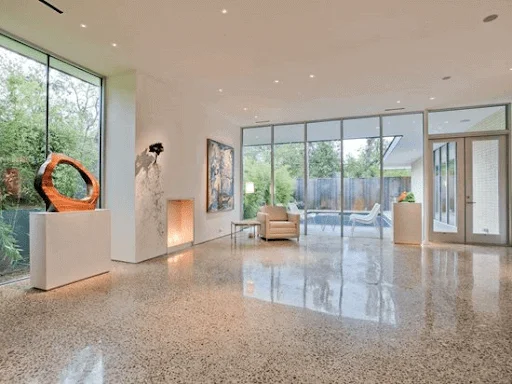
What Are The Concrete Floors The concrete floors can be found everywhere. Under pretty much any type of floor you can find a concrete base. This floor is usually very rough and very absorbent. Concrete is a composite material made from fine and coarse aggregate bonded together with a fluid cement that hardens over time. Its strength and durability make it an unparalleled foundation material. Despite its prevalence, in its raw, unsealed state, the concrete base is unsuitable for general-purpose flooring due to its porosity, which makes it highly susceptible to staining and dust generation. This raw state necessitates a full restoration and finishing process—a journey from a rough, porous base to a durable, aesthetically pleasing floor surface. The transformation involves a combination of mechanical grinding and chemical treatment to ready the material for daily use, making it a viable and stylish main floor. The ability to transform this humble, utilitarian material into a finished, elegant surface is a key reason for the surge in the popularity of concrete floor restoration and finishing techniques globally, including in places like floor cleaning Dublin. Concrete as a Finished Floor: Aesthetics and Durability The polished concrete floors can be found in many commercial and residential units. Unlike covering the concrete with carpeting, tiling, or wood, using the concrete itself as the finished floor offers a unique blend of industrial strength and modern design. The aesthetic appeal of polished concrete is substantial; the floors inspire elegance and class, often showcasing the natural aggregate within the concrete slab, which varies from one location to another. This natural variation ensures that no two polished concrete floors are exactly alike. Beyond aesthetics, the major benefit is durability. Once properly finished and sealed, a concrete floor provides an exceptionally long-lasting and low-maintenance surface that can withstand heavy foot traffic and wear, making it ideal for retail spaces, warehouses, and contemporary homes. This shift from subfloor to feature floor is central to understanding the modern demand for specialized concrete floor cleaning and concrete floor polishing services. Concrete Floor Polishing Technology Mechanical Grinding and Honing Process To be able to use it as the main floor, the surface must be grinded to a smooth finish. This smoothing is not a single-step operation but a progression of mechanical processes using increasingly finer abrasives. Heavy duty industrial grinder will be used to level up the floor, removing surface imperfections, old coatings, and the weakest layer of concrete known as the cement latitude. This initial grinding is aggressive, using metal-bonded diamond tools to achieve a flat surface. Subsequently, the process involves honing the floor with resin-bonded diamond pads, gradually moving through a series of grits, often starting as low as 40-grit and progressing up to 800-grit or higher. Each step in the grinding and honing process removes microscopic scratches left by the previous, coarser grit, which is the mechanism that generates the reflective quality of the polished floor. The result of this meticulous mechanical work is a dense, smooth surface that is intrinsically durable and ready for chemical refinement. The Role of Chemical Densifiers and Hardeners The next critical step in concrete floor polishing technology involves a chemical reaction to fundamentally alter the concrete’s composition near the surface. A number of solvent densifiers will be used to reduce the concrete softness and harden up the concrete. These densifiers are usually lithium, sodium, or potassium silicate-based solutions. When applied, the densifier penetrates the porous surface and reacts with the free lime and calcium hydroxide within the concrete to form a calcium silicate hydrate (CSH) compound. This compound is the same material that gives concrete its strength, but in this application, it fills the pores and voids, significantly increasing the surface density and hardness. This hardening process dramatically improves the floor’s resistance to abrasion and wear, and more importantly, it makes the concrete less absorbent, a vital prerequisite for preventing staining and simplifying future concrete floor cleaning tasks. This chemical hardening is what truly elevates the concrete from a basic slab to a highly durable, finished floor. Step By Step Concrete Polishing Pre-Grinding Preparation and Repair The complete concrete floor restoration process begins long before the first grinder is turned on. The floor must first be thoroughly inspected for cracks, spalls, and pitting. All existing coatings, adhesives, or sealers must be fully removed. Any defects must be repaired using semi-rigid epoxy or polyurea repair products that are matched as closely as possible to the colour of the concrete. This preparatory phase is crucial because polishing will highlight any remaining imperfections. The work area must also be properly masked and contained to protect adjacent surfaces and control dust, even with modern wet or vacuum-assisted grinding techniques. The success of the final polished look depends directly on the thoroughness of this preparation and repair stage. The Grinding and Densification Cycle The core of the process involves the progressive grinding and the application of the densifier. The grinding steps (as outlined above, moving from coarse metal-bonded to fine resin-bonded diamond tools) must be executed sequentially, with each pass overlapping to ensure uniformity. Typically, the densifier is applied after an intermediate grinding step (e.g., after the 80-grit or 150-grit stage). The impregnated densifier is allowed to fully cure, which can take several hours, before grinding resumes. This timing ensures the newly hardened surface is fully integrated before the final polishing passes. The heavy duty industrial grinder is key to ensuring an even and level finish, setting the stage for the final aesthetic. Final Polishing and Glazing The final steps of concrete floor polishing involve using the finest resin-bonded diamond pads (e.g., 400-grit, 800-grit, 1500-grit, or even 3000-grit) to achieve the desired level of gloss. The final coating will slightly glaze the surface with a matt or a semi gloss finish. This final coating is usually a stain-guard or an impregnating sealer that is applied after the polishing is complete. This protective layer is not a film that sits on top but a chemical barrier that penetrates the surface